Lead
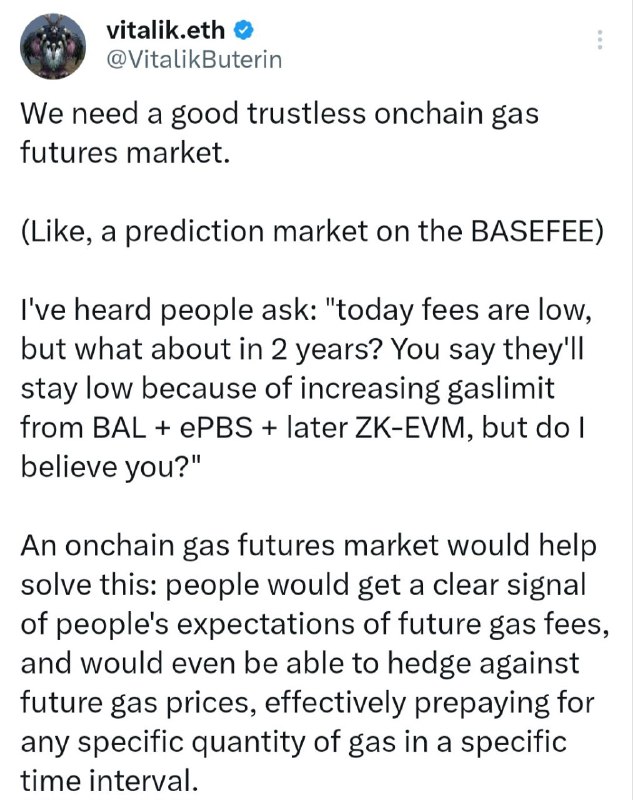
Ethereum co-founder Vitalik Buterin has proposed creating a trustless, on-chain market for gas futures to help users hedge against the volatility of Ethereum transaction fees. The concept, similar to prediction markets, could enable both risk management and speculation on future network costs as activity scales.
Key Developments
- Buterin suggests a mechanism akin to a prediction market for gas, where participants could trade expectations of future network fees.
- The goal is to provide a hedging tool for users and developers who face uncertainty in gas costs, which can spike during periods of high demand.
- While gas fees are relatively low at present, Buterin notes they could rise as the network evolves, citing potential impacts from ongoing and future upgrades such as enshrined proposer‑builder separation (ePBS) and wider adoption of ZK‑EVM technologies.
The proposal envisions a "trustless onchain gas futures market" to improve planning and fee predictability across the Ethereum ecosystem.
Why It Matters
Ethereum’s fee market is inherently variable due to demand for block space. A futures-style market could:
- Allow users and dapps to lock in expected costs for future transactions
- Improve price discovery for future network conditions
- Offer new risk management instruments for protocols and service providers
- Attract liquidity and speculation around fee dynamics, potentially smoothing volatility over time
For context on how gas works today, see Ethereum’s developer documentation on gas and fees. As scaling solutions mature, including ZK‑rollups, overall throughput is expected to increase—yet fee outcomes can still vary by demand, design choices, and implementation details.
Implementation Considerations
- The market would need to be trustless and on-chain, minimizing reliance on centralized intermediaries.
- Effective design would likely focus on transparent, verifiable references for future gas costs, enabling settlement grounded in observable on-chain data.
- Key challenges include liquidity, oracle design, contract standardization, and ensuring that hedging tools are accessible without introducing undue complexity or risk.
Market Impact
If implemented, an Ethereum gas futures market could become a foundational derivatives instrument for the ecosystem. It may benefit wallets, dapps, DeFi protocols, and infrastructure providers by enabling budget predictability and risk hedging, while also introducing a new venue for speculative activity tied to network usage trends.
Conclusion
Buterin’s proposal underscores a broader push to make Ethereum fees more predictable and manageable as the network scales. While no rollout timeline has been announced, the idea of on-chain gas futures is likely to spur discussion among developers, protocol designers, and market makers about practical paths to implementation and the safeguards needed to protect users.