Lead
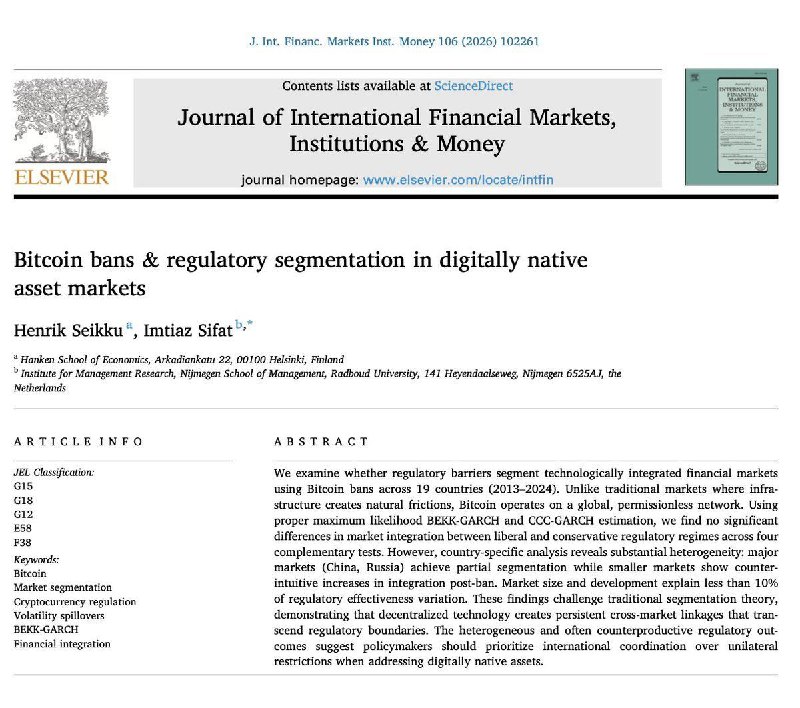
A peer-reviewed study finds that national bans on Bitcoin have largely failed to fragment the global market for the asset. Analyzing 19 countries over nearly a decade, researchers report that Bitcoin’s decentralized network sustains market integration even under strict prohibitions, with China showing only partial segmentation and some smaller markets becoming more integrated post-ban.
Key Findings
- Bitcoin bans are largely ineffective at disrupting global market integration.
- China’s restrictions resulted in only partial market segmentation.
- Smaller markets sometimes experienced counterintuitive increases in integration after imposing bans.
- Unilateral restrictions are deemed largely ineffective, suggesting that international coordination would be required to meaningfully alter crypto market dynamics.
Study Details
The research, titled "Bitcoin bans & regulatory segmentation in digitally native asset markets," was published in the Journal of International Financial Markets, Institutions & Money (Volume 106, September 2023, Article 102261). Authors Henrik Seikku and Imtiaz Sifat examined 19 countries from 2013 to 2022, evaluating whether regulatory barriers can segment technologically integrated financial markets.
Using network theory and cross-market integration metrics, the study assesses how regulatory interventions interact with Bitcoin’s decentralized structure. The findings indicate that Bitcoin’s global connectivity and frictionless cross-border transfer characteristics help preserve market linkages even when individual jurisdictions attempt to isolate local trading activity.
For more on the journal, visit the Journal of International Financial Markets, Institutions & Money.
Regional Highlights
- China: Despite comprehensive restrictions, the market showed only partial segmentation, indicating that traders and capital flows continued to connect with global pricing and liquidity.
- Smaller Markets: In several jurisdictions with limited domestic liquidity, bans unexpectedly increased integration, potentially as activity shifted toward offshore venues and global exchanges, reinforcing cross-border linkages.
Policy Implications
- Unilateral bans are limited in effectiveness: Country-by-country suppression efforts do not meaningfully fragment a globally connected, digitally native market like Bitcoin.
- Coordination matters: To significantly impact crypto market structure, multilateral regulatory coordination would be more consequential than isolated measures.
Market Impact
While the study focuses on market structure rather than price forecasting, its conclusions underscore how decentralized networks can resist regulatory segmentation. For market participants, this suggests that liquidity, price discovery, and arbitrage are likely to remain globally distributed, even amid periodic regulatory crackdowns.
Conclusion
The peer-reviewed evidence indicates that Bitcoin bans have not succeeded in severing global market integration. With China showing partial effects and some smaller markets becoming more connected post-ban, the study concludes that unilateral restrictions are largely ineffective, and any substantial market fragmentation would require international policy coordination.