Lead
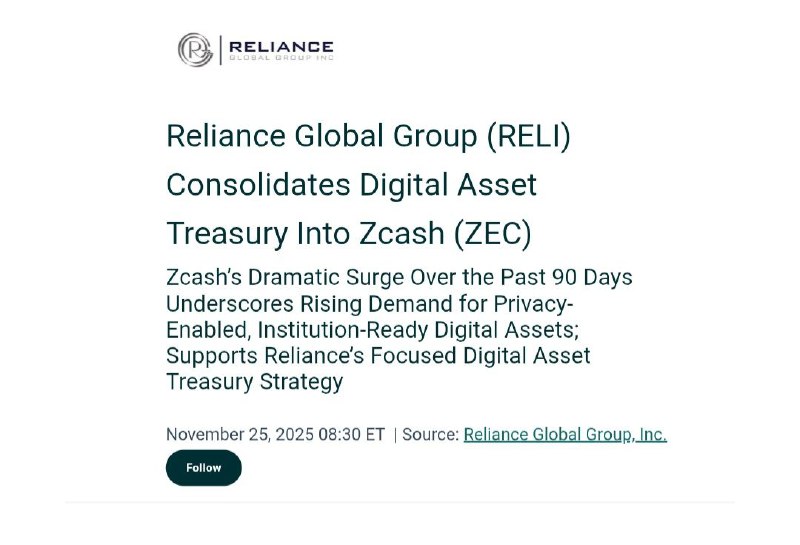
Public company Reliance Global Group (RELI) has reallocated its entire digital asset treasury into Zcash (ZEC), fully exiting positions in Bitcoin (BTC), Ethereum (ETH), Cardano (ADA) and XRP. The company said the shift reflects a focus on privacy-enabled, institution-ready digital assets, following strong momentum in Zcash over the past 90 days. The announcement was made on November 25, 2025, at 08:30 ET.
Key Developments
- Reliance Global Group announced a complete exit from BTC, ETH, ADA, and XRP holdings acquired in September–October 2025.
- All digital asset funds have been consolidated into Zcash (ZEC).
- The company highlighted a recent sharp rise in demand and price for ZEC over the past 90 days.
- Strategy centers on privacy-enabled and institution-ready digital assets.
Why Zcash?
Zcash is a privacy-focused cryptocurrency that supports shielded transactions using zero-knowledge proofs (zk-SNARKs). This design allows users to verify transactions without revealing sensitive information, a feature that appeals to institutions prioritizing data confidentiality and compliance-sensitive operations.
The company described the shift as aligning its treasury strategy with assets that offer enhanced privacy features while being suitable for institutional frameworks.
Market Context and Implications
- While many corporate treasuries diversify across highly liquid large-cap crypto assets, a full consolidation into a privacy coin is uncommon and may signal evolving institutional perspectives on privacy and confidentiality in digital finance.
- Zcash has seen notable momentum over the last quarter, which the company referenced as part of its rationale. Specific performance figures were not disclosed.
- The move could encourage wider discussion around corporate treasury management in crypto, especially regarding the balance between liquidity, compliance, and privacy.
Looking Ahead
Stakeholders will be watching for further disclosures from Reliance Global Group on treasury policy, risk management practices, and any subsequent adjustments tied to market or regulatory developments. The reallocation underscores growing interest in privacy-centric digital assets within institutional strategies.