Lead
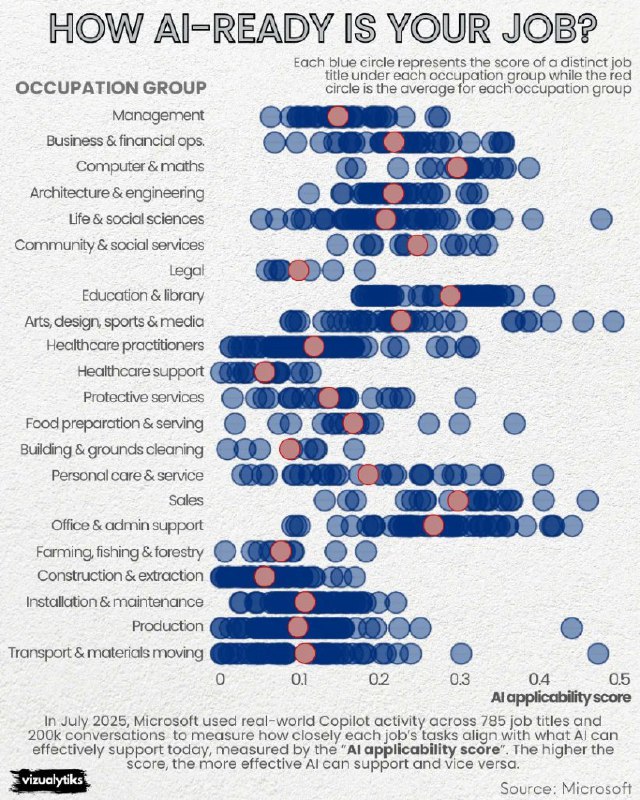
A new Microsoft analysis assigns an AI applicability score from 0 to 1 across 785 occupations, highlighting how unevenly artificial intelligence may affect the labor market. The study points to higher AI applicability in fields like food service, legal, and personal care, while management and engineering roles show lower applicability. A July 2025 pilot explored AI use in summarization tasks.
Key Developments
- The study introduces an "AI applicability score" metric (0–1) to gauge how suitable different jobs are for AI augmentation.
- Visualization details show blue circles representing individual job titles and a red circle indicating the average score within each occupational group.
- The analysis indicates that AI's potential influence varies widely by sector, suggesting a differentiated impact on job tasks and workflows.
Occupations With Higher AI Applicability
- Food preparation & serving
- Legal
- Personal care & service
These sectors show a higher concentration of roles with elevated AI applicability scores, implying strong potential for AI-assisted task execution such as drafting, scheduling, documentation, or standardized service support.
Occupations With Lower AI Applicability
- Management
- Architecture & engineering
These groups display lower concentrations of high scores, indicating more complex, non-routine, or judgment-heavy tasks that may be less directly augmented by current AI systems.
Methodology Snapshot
- Metric: AI applicability score (0–1) for each role
- Scope: 785 job titles across multiple occupational groups
- Visualization: Individual roles as blue markers; group averages as red markers
- Pilot note: A July 2025 workplace pilot tested AI for summarization tasks, reflecting early practical evaluations of AI integration in everyday workflows
Market and Workforce Implications
- The uneven distribution of AI applicability suggests that the labor market impact will be highly sector-specific.
- Roles with higher scores may see faster adoption of AI copilots and automation for routine or text-heavy tasks.
- Lower-scoring fields may prioritize AI-assisted tools that support, rather than replace, specialist judgment and complex design work.
- Organizations may benefit from task-level audits, reskilling initiatives, and targeted AI adoption strategies tailored to their occupational mix.
Conclusion
Microsoft’s mapping of AI applicability across 785 occupations underscores that AI’s impact will be heterogeneous rather than uniform. As real-world pilots (such as AI-driven summarization) expand, employers and policymakers will need to focus on task-specific integration, reskilling, and responsible deployment to capture benefits while mitigating disruption.