Lead
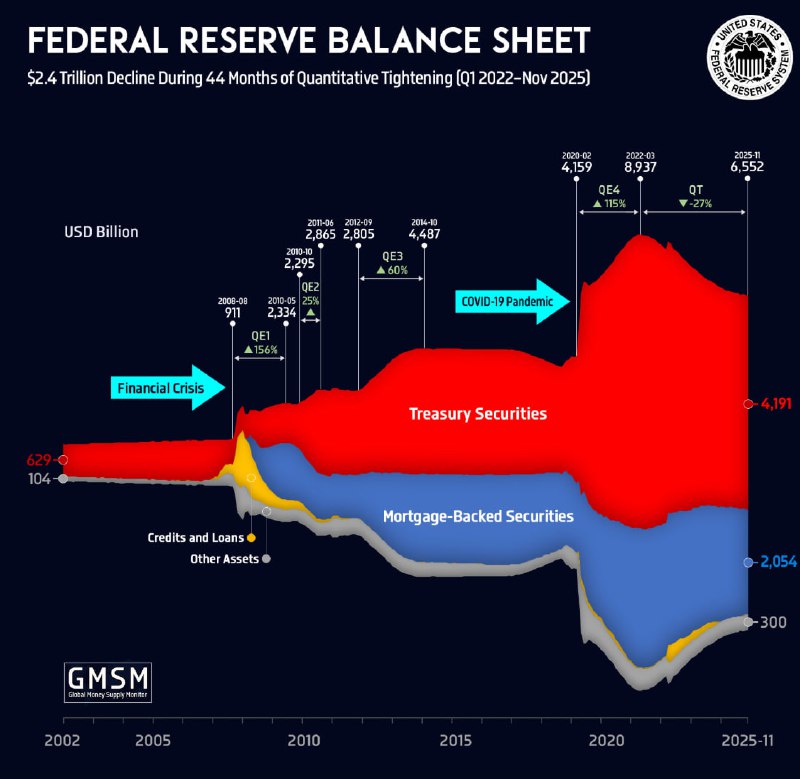
The Federal Reserve’s balance sheet has contracted by $2.4 trillion over 44 months of quantitative tightening (QT) from Q1 2022 through November 2025. After peaking near $8.965 trillion, holdings of Treasury securities and mortgage‑backed securities (MBS) have declined markedly, a trend closely watched by crypto markets sensitive to U.S. dollar liquidity.
Key Developments
- The Fed’s balance sheet reached a peak of about $8.965 trillion following unprecedented expansion during the COVID-19 period.
- Since the start of QT in Q1 2022, total assets have fallen by approximately $2.4 trillion through November 2025.
- Treasury securities constitute the largest share and have declined to around $4.191 trillion.
- Mortgage‑backed securities (MBS) have decreased to about $2.054 trillion.
- Asset categories on the balance sheet include Treasury securities, MBS, credits and loans, and other assets.
For official weekly balance sheet data, see the Federal Reserve’s H.4.1 statistical release: federalreserve.gov/releases/h41/current.htm.
Context
The balance sheet ballooned during the Global Financial Crisis and surged again during the COVID‑19 pandemic as the Fed purchased Treasuries and MBS to stabilize markets and support the economy. Beginning in 2022, the central bank reversed course, allowing securities to roll off without reinvestment and thereby reducing system liquidity.
Why It Matters for Crypto
- Crypto markets, including Bitcoin and Ethereum, often track shifts in global liquidity. QT can tighten financial conditions, historically creating headwinds for risk assets.
- Reduced Fed holdings may correspond with lower bank reserves, which can influence market depth and risk appetite across equities, bonds, and digital assets.
- Traders monitor the pace of Treasury and MBS runoff as a proxy for liquidity that can affect crypto market volatility and capital flows.
Market Lens
While price reactions can vary over shorter horizons, macro liquidity remains a key narrative driver for digital assets. The ongoing balance sheet normalization has become a central input for crypto risk models and positioning, alongside policy rate expectations and Treasury issuance dynamics.
What to Watch Next
- The monthly runoff pace of Treasuries and MBS, and any adjustments to caps or reinvestment policies.
- Signals from upcoming FOMC communications on the eventual endpoint of balance sheet normalization.
- Cross‑asset liquidity conditions and their spillover into Bitcoin and broader altcoin performance.
Conclusion
The Fed’s balance sheet has contracted by $2.4 trillion since QT began in 2022, with notable declines in Treasuries and MBS through November 2025. As the runoff continues, crypto markets will closely track liquidity trends that could shape volatility and investor appetite into 2026.