Lead
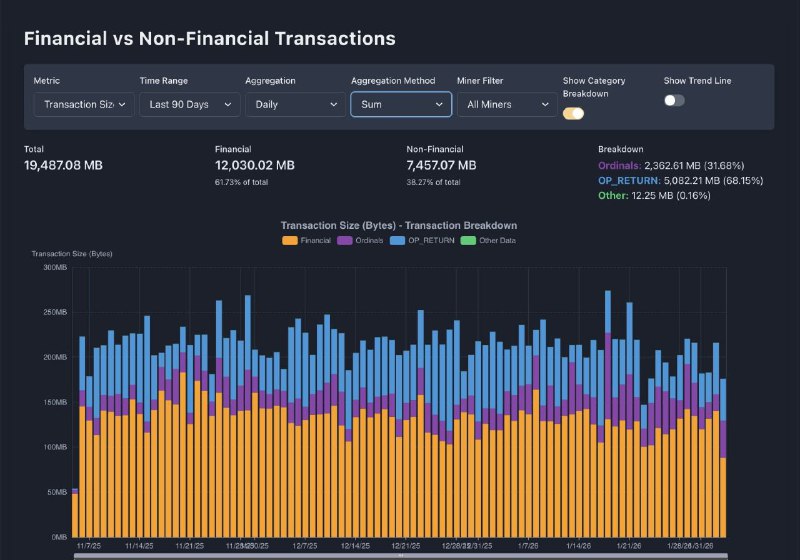
Bitcoin’s blockchain expanded by roughly 19.5 GB over the last 90 days, with about 7.5 GB attributed to non‑financial activity often described as “spam” by critics. Financial transactions accounted for the remainder, highlighting the ongoing tension over how Bitcoin’s limited blockspace is used.
Key Developments
- Total on-chain data added (90 days): 19,487.80 MB
- Financial transactions: 12,030.02 MB
- Non‑financial transactions: 7,457.07 MB
Non‑financial usage includes content embedded through OP_RETURN metadata and Ordinals inscriptions, both of which store data on-chain that is not directly related to value transfer. While supporters view these features as legitimate uses of Bitcoin’s settlement layer, detractors argue they crowd out payments and push up network fees during peak demand.
By the numbers
- Total growth: ~19.5 GB of additional data recorded on the blockchain in 90 days
- Financial vs. non‑financial: ~12.0 GB vs. ~7.5 GB, respectively
- Primary non‑financial drivers:
OP_RETURNmetadata andOrdinalsinscriptions
Context: Financial vs. Non‑Financial Transactions
- Financial transactions are standard Bitcoin transfers that move value between addresses.
- Non‑financial transactions utilize Bitcoin’s scripting and data‑embedding capabilities to store arbitrary content on-chain. Examples include:
OP_RETURNfields embedding small pieces of dataOrdinalsinscriptions recording media or text in transaction data
This mix directly affects blockspace competition. When non‑financial activity rises, it can increase congestion and fees for all users. Conversely, periods of lower activity help ease mempool pressure and reduce average fees.
Market Impact
Although prices are driven by many factors, blockspace utilization remains a key operational metric for Bitcoin. Sustained non‑financial demand can influence fee markets, mining revenue composition, and user experience for everyday transactions, particularly during periods of heightened on‑chain activity.
Looking Ahead
Debate over the role of non‑financial data on Bitcoin is likely to continue as developers, miners, and users balance open access to blockspace with the network’s primary function as a peer‑to‑peer payments system. Monitoring the share of non‑financial transactions will remain important for assessing future fee dynamics and network efficiency.