Lead
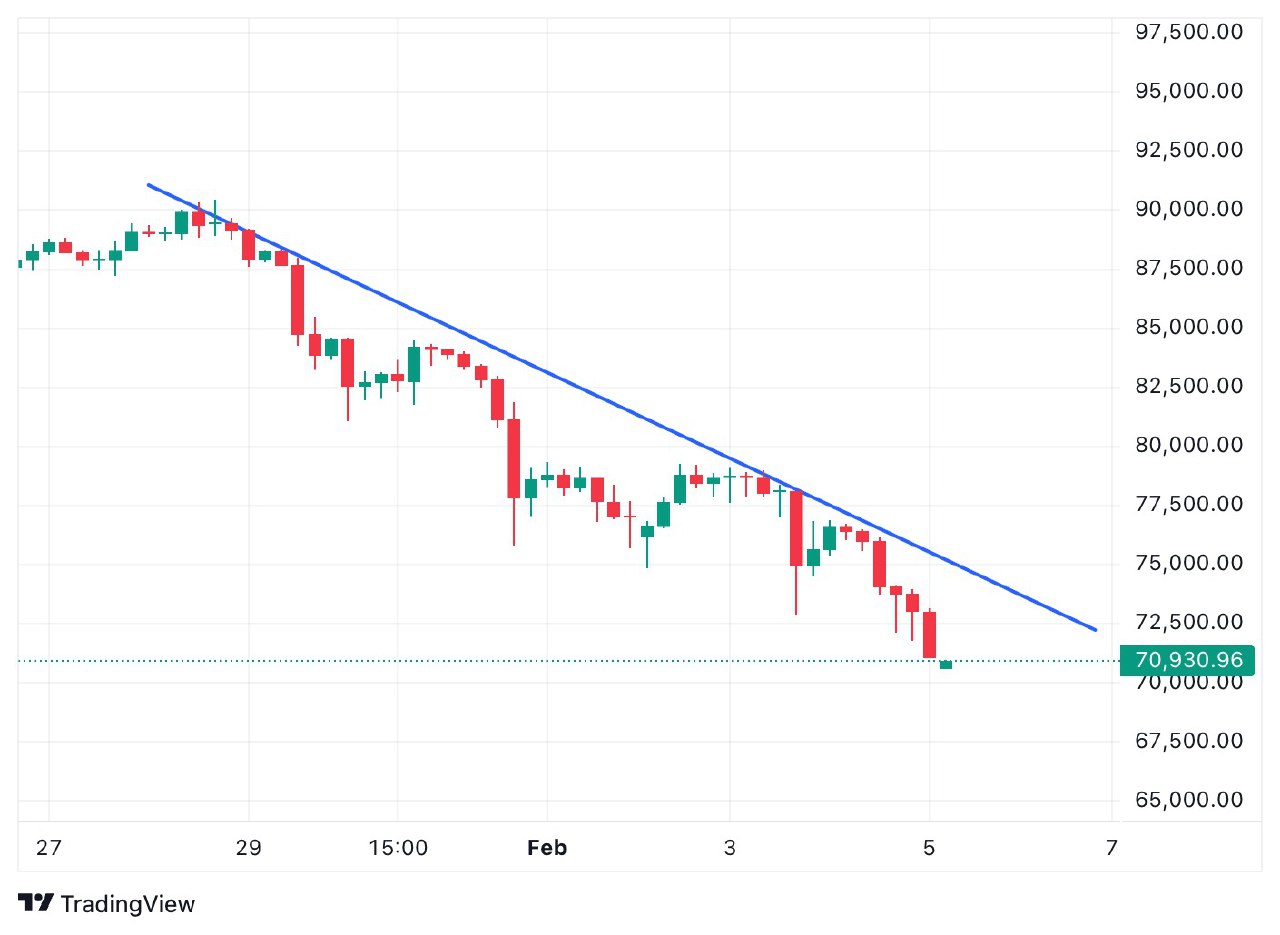
Bitcoin slid below $71,000 and briefly tested the $70,000 level on major venues, triggering a wave of liquidations and heightened volatility across crypto markets. On‑chain indicators show mounting pressure on short‑term holders, while analysts flag weak spot demand and parallels to previous bear phases.
Key Developments
- Price low: Bitcoin touched $70,119 on February 5, its lowest level since late 2024. On some exchanges, including Bitstamp, price dipped below $70,000 intraday.
- Liquidations surge: Over the last 24 hours, 175,473 traders were liquidated, with a total of $854.68 million in positions wiped out. The largest single liquidation was a BTCUSDT order worth $11.36 million, according to CoinGlass data.
- Short‑term holder strain: On‑chain metrics SOPR and STH MVRV fell below 1, indicating realized losses and forced selling among short‑term holders. A widely tracked STH MVRV reading hovered near 95.4%, underscoring capitulation risk.
- Positioning risk: Long positions on Bitfinex are at their highest since late 2023, raising the potential for further long‑side liquidation cascades if downside continues.
- Thin liquidity zone filled: Analysts note the market has now “back‑filled” a historical low‑volume supply gap between $70,000–$80,000, a zone that offered little support on the way down. Price is approaching the 2024 consolidation region, an area of denser historical demand, while unrealized paper losses (in USD terms) have grown comparable to past bear‑market extremes.
Market Impact
- The total crypto market capitalization has dropped about 20% year‑to‑date, including a ~6% decline over the last day.
- Ethereum (ETH) fell to the $2,079–$2,095 range, while Solana (SOL) slipped to around $91.
- Bitcoin’s market dominance stands near 59.05%, and the Crypto Fear & Greed Index plunged to 12 ("extreme fear"). See the latest reading at alternative.me.
- Crypto‑exposed equities also weakened; broader risk assets were pressured amid a concurrent sell‑off in U.S. tech stocks.
- Several intraday CME Bitcoin futures gaps were quickly closed, highlighting elevated volatility in derivatives markets (CME BTC futures).
Macro and Flows
- Market participants cite a confluence of drivers: a wave of long liquidations, outflows from spot Bitcoin ETFs, and a broader risk‑off shift tied to global macro dynamics rather than crypto‑specific issues.
- A recent note from Goldman Sachs indicated that capital flows remain skewed toward selling, with buyers largely staying on the sidelines.
- Analysts also pointed to easing U.S.–Iran tensions possibly prompting profit‑taking in gold, a move that can influence cross‑asset positioning and liquidity conditions.
On‑Chain and Historical Context
- On‑chain analytics firm CryptoQuant highlighted similarities in the UTXO profile to the 2022 bear trend, when Bitcoin fell from about $65,000 to $15,000. While history does not repeat precisely, the resemblance has prompted caution among traders (CryptoQuant).
- Heatmap analyses of long‑term holder supply show a historic demand zone around $55,000–$65,000. Current price action is edging toward the 2024 consolidation band, with the 200‑week moving average and the short‑term holder cost basis being closely watched technical reference points.
Outlook
- With seller pressure still evident and spot demand soft, near‑term conditions remain fragile. Key variables to monitor include spot ETF flows, derivatives funding, Bitfinex long positioning, and on‑chain loss realization.
- Some analysts warn that past bear markets have seen 70%+ drawdowns from cycle peaks, implying potential extremes near the mid‑$30,000s if history rhymes—though that is not a foregone conclusion.
Conclusion
Bitcoin’s swift drop through the $70,000s has reset sentiment to extreme fear and flushed out leveraged longs, while on‑chain signals confirm stress among short‑term holders. Whether dense historical demand near the 2024 consolidation zone can stabilize price will likely hinge on the trajectory of ETF flows, macro risk appetite, and renewed spot buying interest.