Lead
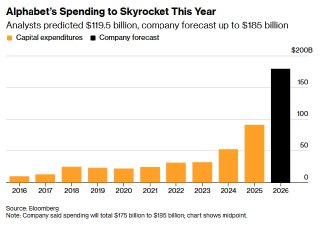
Alphabet is preparing to dramatically increase capital expenditures to accelerate its artificial intelligence strategy, with internal forecasts indicating spending could reach $175–$185 billion in 2026. That potential outlay far exceeds analyst expectations of about $119.5 billion, highlighting the scale of the company’s planned data center and AI infrastructure buildout.
Key Developments
- Capex trajectory: Alphabet’s capital expenditures have climbed steadily since 2016, with projections indicating a sharp jump between 2025 and 2026.
- Record allocation: The company indicated spending could total $175–$185 billion in 2026 (with mid-point assumptions used in charting), a figure well above prior analyst models near $119.5 billion.
- AI-first infrastructure: The anticipated increase is tied to the race for AI infrastructure, including hyperscale data centers, advanced networking, and high-performance compute (e.g., GPUs/TPUs) needed to train and deploy large-scale AI models.
Strategic Context
Alphabet’s move underscores the intensifying competition among major technology firms to secure compute capacity, optimize AI model performance, and scale cloud-based AI services for enterprise customers. The anticipated surge in spending aligns with:
- The need to expand data center footprints to support generative AI workloads and latency-sensitive applications.
- Long-term commitments to specialized chips (including in-house
TPUdevelopment) and high-bandwidth networking. - Building sustainable energy and cooling solutions as power requirements for AI clusters escalate.
Market Impact
A capex program of this magnitude would reverberate across the broader technology supply chain and capital markets:
- Semiconductor ecosystem: Potential tailwinds for compute suppliers, memory vendors, optical networking, and power systems.
- Cloud and enterprise AI: Greater capacity could accelerate rollout of AI services to developers and enterprises, potentially compressing innovation cycles.
- Capital intensity vs. margins: While near-term spending may pressure free cash flow, management is likely targeting multi-year monetization through cloud AI services, advertising optimization, and AI-enabled productivity tools.
Outlook
If realized, Alphabet’s 2026 capex would mark a watershed moment in the AI infrastructure race. The scale suggests a sustained commitment to building competitive moats in compute, data, and platforms that enable next-generation AI applications. Execution will hinge on supply chain resilience, power availability, and translating infrastructure scale into durable revenue growth.
The projected $175–$185 billion capex range versus $119.5 billion analyst expectations signals an aggressive AI posture and a potential re-rating of investment assumptions across Big Tech’s AI arms race.
Conclusion
Alphabet’s forecast for record AI-focused capital expenditures in 2026 signals a decisive push to lead in generative AI and cloud infrastructure. The planned acceleration—from a steady multi-year buildout to a sharp 2026 ramp—positions the company to compete at scale, with significant implications for technology suppliers, enterprise AI adoption, and the broader market.